Life is short,have fun!!!

Lifestyle, Travel & Photography. If you want a lifetime memory, take a photo.

Archive for the month “May, 2012”

Frequent-flying females

Hotels need to do much more than put skirt-hangers in closets to woo the female traveller. 

Hotels need to do much more than put skirt-hangers in closets to woo the female traveller.

On your next business trip, take a good look around the airport lounge and in the aircraft’s business class cabin. Chances are you’ll find around one passenger in three is a woman.

Take the same snap poll at your hotel of choice and the numbers should take similar shape.

So why does it sometimes seem that airlines and hotels are ignoring a third of their market?

Advertisement: Story continues below

According to Roy Morgan Research, 35 per cent of Australia’s estimated 2.1 million domestic business travellers – people who’ve made at least one business trip by air within Australia in the last 12 months – are women.

Women also represent 31 percent of Australia’s half-million international business travellers.

A Cornell University report claims that while female businesspeople expect to be treated equally to men, their travel needs are not the same.

“Given the dramatic increase in women business travelers, addressing the needs of this market segment has become increasingly critical for hotels” says Judi Brownell, from Cornell’s School of Hotel Administration.

“Women are developing a clear and consistent message about the need to feel safe, comfortable, empowered, and pampered.”

Brownell says hotels need to do much more than put skirt-hangers in closets to woo the female traveller.

Up in the air

There are some interesting trends in gearing travel towards the female flyer.

Virgin Australia was one of the first airlines in the world to install a ‘Ladies Only’ bathroom in the business class cabin of on its Boeing 777s.

“The Ladies Only bathroom provides additional space and lighting and is valuable when wanting to present a fresh face on arrival after a long haul flight” explains Alison Chalmer, Virgin Australia’s General Manager of Product.

And while a handful of airlines are moving towards unisex inflight amenity kits, Virgin’s female amenity kits for international business class include make-up wipes and a hairbrush.

Another smart touch is the inclusion of a mirror for each seat in Cathay Pacific‘s new business class.

“The mirror is a little touch we added during passenger testing” says Alex McGowan, Cathay Pacific’s Head of Product.

“Ladies said that it would be nice if they could do a little touch-up, and men said that it would be nice if the ladies weren’t doing their makeup in the bathrooms!”

Hotels are also starting to think about female business travellers as more than a person who ticks the ‘Ms’ box on the checkin form.

The Pan Pacific at San Francisco offers female guests a discreet security escort from the lobby to their room.

Wyndham and Loews hotels have set aside ‘networking tables’ in hotel restaurants for solo women who prefer to dine with others rather than sit alone.

And in typically glam style, W Hotels’ ‘Wonder Woman’ packages include three lip glosses, a signature fragrance, black mascara, a silk eye mask and free cocktail.

The bloke-free hotel floor

Some hotels are even opening women-only floors from which all men – not just guests but male porters and room service staff – are barred.

“Women-only floors can be a good idea in cities where women may feel vulnerable when travelling alone” suggests Suzi Dafnis, Community Director of the Australian Businesswomen’s Network.

“If that choice was available to me, I’d probably take it” Dafnis says. “I don’t know any woman that would say no to a room with high-powered hair dryers, a good quality cosmetic mirror and lighting, beautiful bath salts or healthier options on the menu.

“London, Vancouver, Singapore and New York – four cities that where hotels have this feature – don’t strike me as cities where it’d be out of a sense of safety that women would choose to stay in a women-only floor.”

Dafnis also suggests that “Australian standards are also such that safety wouldn’t be the main motivator.”

A business travel survey by the UK’s Barclaycard indicated that only 24 per cent of female business travellers wanted women-only floors, with improved gyms being a higher priority.

That can also include in-room fitness gear for women who’d rather not visit the hotel gym.

Some Hilton and Marriott hotels let you borrow low-tech workout equipment such as mats and weights, while Westin’s dedicated Workout Rooms come with your choice of a treadmill or stationary bike plus extras such as dumb-bells, a yoga mat, Swiss ball, jump rope and even fitness DVDs.

Hong Kong’s Metropark hotel in Wanchai boasts a women-only ‘She’ floor where the rooms are decorated along female lines with ‘themes’ of flowers and ballet and Thann cosmetics.

But women-only floors have met with mixed results as well as mixed response.

In early 2011 Brisbane’s Portal Hotel decreed its fifth floor would be a ‘man-free zone’.

Each of the 11 rooms was stocked with fresh flowers and candles, female toiletries like a cleanser and face mask, hair straighteners and magazines such as Madison, Vogue and Harper’s Bazaar.

There was even a ”Pamper Bar’: think of a mini bar stocked with organic beauty products instead of booze!

While the concept appears to have been well received by guests, the doors to the female-only floor were thrown open to men (and the raft of women’s touches scrapped) when the Portal was rebranded as part of the boutique Diamant chain.

Copenhagen’s Bella Sky Hotel, a conference hotel in the city’s Orestad district, faced legal action last year when a court ruling by the Danish Gender Equality Board decreed that its women-only floor was discriminatory and therefore illegal.

“We have 814 other rooms, and there are 20 reserved for women. That means there are 794 rooms for everyone” said hotel chief Anders Dueland, who has flouted the ruling and continues to keep the ‘Bella Dona’ floor as a haven solely for female guests who value the scented rooms with flowers, and bathrooms fitted with “spacious showers, lots of mirrors and large hair-dryers”.

“In Denmark, there are running races reserved for women, there are bicycle races reserved for women, there are pools where the changing rooms are just for women or just for men” Dueland argues. “There are toilets just for women. Is that discrimination?”

How good are airlines and hotels at catering for women business travellers? And are women-only floors really discrimination or a better way to cater specifically for their needs?

David Flynn is a business travel expert and editor of Australian Business Traveller.

Twitter: @AusBT

Australia cuts its rates more than forecast to 3.75%

Fruit seller in Sydney
A slowdown in consumer price growth has made it easier for the central bank to cut rates

The Reserve Bank of Australia has cut interest rates more-than-expected because economic conditions were “somewhat weaker” than forecast.

It added that inflation had also moderated in recent months.

The bank cut its key rate to 3.75% from 4.25%. Most analysts were expecting a 0.25 percentage point cut.

There have been increasing signs that Australia‘s economy is being hit by a slowdown in global growth and demand for its resources.

“This decision is based on information received over the past few months that suggests that economic conditions have been somewhat weaker than expected, while inflation has moderated,” the Reserve Bank of Australia (RBA) said in a statement.

“Growth in the world economy slowed in the second half of 2011, and is likely to continue at a below-trend pace this year.”

Aggressive support?

One of the biggest headaches facing policymakers over the past year or so has been the fact that Australia was developing a two-speed economy.

While Australia’s mining and resources sector has been booming, the other parts of Australia’s economy have not been doing as well.

Figures out last week only compounded the fears of analysts and politicians.

A report showed that new home sales fell to their lowest level in more than a decade in March. At the same time, home prices have fallen for a fifth straight quarter, while retail sales have shown little growth.

The government welcomed the interest rate move by the central bank.

“This is the interest rate cut that households and small businesses have been hanging out for,” said Wayne Swan, Australia’s Treasurer and Deputy Prime Minister.

“It is very welcome, it is well deserved and it is certainly much needed by households under financial pressure.”

Analysts said that the surprise move by the central bank showed that it was trying to give growth a positive jolt and that it opened the way for more rate cuts in coming months.

“It suggests that the RBA is pretty worried about where growth is headed and some aggressive monetary support was needed,” said Matthew Circosta of Moody’s Economy.

“I think the bias is towards more rate cuts. With the low inflation outlook it gives them scope to cut rates further.

BBC News

‘How Boko Haram attacks have changed the Maiduguri where I grew up’

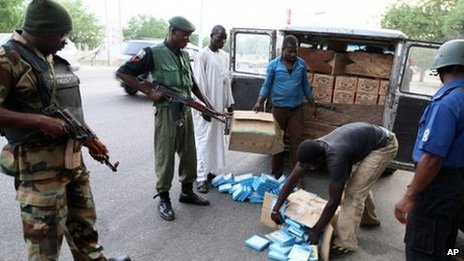
Security officials search a vehicle along the Gombe-Maiduguri (archive shot)ri expressway in Nigeria Maiduguri residents complain that soldiers do not treat them well

Jimeh Saleh from BBC Hausa returns to his home town of Maiduguri in the far north-east of Nigeria for the first time in almost a year – to find the city is a mere shell of its once lively self, following a spate of deadly attacks by the Boko Haram Islamist group.

As dusk falls in Maiduguri, and the bright afternoon sun gradually turns orange and slowly dips in the evening sky, a muezzin leads the call to pray.

His spirited voice echoes from a pair of loud speakers on a minaret atop one of the oldest mosques in town.

The faithful observe the evening Maghreb prayer – and then have to go straight on to the Isha, the late evening prayer, because Maiduguri has to live under a strict 19:00-06:00 curfew.

Today’s quiet nights – the uncertainty and the insecurity – are a far cry from the Maiduguri I grew up in.

Firmly padlocked houses

My home town, in the far north-east of Nigeria, is also the stronghold the country’s radical Islamist group, Boko Haram.

“We live in constant fear, and you are the only journalist I can talk to, because I know you personally”

And in the past few months, the group has carried out a number of violent and devastating attacks in many parts of Nigeria – including drive-by shootings and bombings in Maiduguri, even the central mosque in December.

Back from London in Maiduguri for the first time in almost a year, the town is as dusty as I left it – but it appears poorer – and so do its industrious and boisterous people.

No more do buses, taxis, beggars, vendors and shop keepers hustle for business late into the night.

Families are no longer able to afford three meals a day.

Property speculators are complaining that business is down, and some are suffering losses.

“Closing shops at 7pm is just like working half-day,” said an economist with the University of Maiduguri who, like most people I spoke to, asked to remain anonymous.

“The economy here is driven by the informal sector which has no closing hours,” he added.

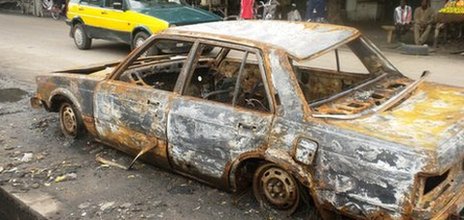
Burnt out car in Maiduguri Boko Haram attacks have left Maiduguri a shell of its former self

“We live in constant fear,” one resident told me, ”and you are the only journalist I can talk to, because I know you personally, but please do not reveal my name.”

Many people fled Maiduguri months ago in the wake of the killings, leaving behind firmly padlocked houses.

Some of the town’s wealthy businessmen have relocated their enterprises to other states.

Soldiers accused

When bombs went off on Christmas Day 2011 in churches in Abuja and Jos killing at least 40 people, Maiduguri was placed under a state of emergency because of the many Boko Haram members who are based there.

Since then, gun-toting soldiers have set up countless checkpoints and taken up positions outside churches, police stations and other high-profile locations that have previously been Boko Haram’s targets.

The soldiers are there to protect the residents of Maiduguri – but people seem united in their condemnation of the curfew and the militarisation of the streets.

They accuse the soldiers of torture and other human rights violations.

Boko Haram squads target soldiers and security agents with explosives, either in their fortified positions or in their patrol vehicles.

After an attack, the soldiers go into neighbouring houses, and are said to indiscriminately beat up the male occupants.

The army denies this is happening – nevertheless, it is a recurring cry that is hard to ignore.

Shoppers’ paradise

Maiduguri’s age-old commercial centre used to be on Babban Layi, which simply means “a wide street”.

It used to be a shoppers’ paradise for textile, electronics, clothing, and household items.

Lebanese and Chadian merchants jostled alongside low-tech con men and pickpockets – all hoping to get a slice of the bulging sacks of money freely freighted around on wheelbarrows.

“Many in town are resigned to their fate and have resorted to prayers to try to rediscover the virtues of peace and hospitality”

Overloaded trucks, known locally as giwa-giwa, transported goods from Babban Layi to neighbouring countries such as Chad and Cameroon, and even to distant places like Sudan and the Central African Republic.

But this once thriving regional trading hub is now almost empty – brought to a virtual standstill not least because the borders were closed as a result of the state of emergency.

For many months now, the labourers who load the trucks, the merchants, the truck drivers and many others have been “surviving by the grace of God”.

The authorities in Maiduguri remain hopeful that things will get better.

“We are not at all pleased by the state of insecurity in Maiduguri and very soon the situation will improve,” Borno state’s information commissioner, Inuwa Bwala, says.

The questions many Maiduguri residents want answered is: When will the borders reopen and when will the army leave the streets?

“Since the state of emergency the federal government has taken over security matters here and the announcement to close the borders was made from Abuja,” Mr Bwala said.

It is, however, not all a tale of gloom – despite the curfew and the explosions.

Among the lucky few are bicycle dealers and mechanics: There has been a boom in sales since the banning last year of motor bikes after a series of drive-by killings were committed by gunmen on the back of bikes.

Despite this glimmer of hope, the situation in Maiduguri seems pretty desperate.

There is a palpable sense of fear.

Many people are resigned to their fate and have resorted to prayer to try to rediscover the virtues of peace and hospitality – which, once upon a time, was the defining feature of my home town.


Boko Haram: Timeline of terror

Map locator
  • 2002: Founded
  • 2009: Hundreds killed when Maiduguri police stations stormed
  • 2009: Boko Haram leader Mohammed Yusuf captured by army, handed to police, later found dead
  • Sep 2010: Freed hundreds of prisoners from Maiduguri jail
  • 2010-2011: Dozens killed in Maiduguri shootings
  • June 2011: Police HQ bombed in Abuja
  • Aug 2011: UN HQ bombed in Abuja
  • Dec 2011: Multiple bomb attacks on Christmas Day kill dozens.

Source : BBC News

badlandsbadley's avatarThe Life and Times of Nathan Badley...

There are some ideas that seem bad. Then there are ideas that set a landmark for awfulness, ideas that make every appalling decision you have ever made seem mildly brilliant. These ideas do not come along very often, so when they do it is always something very special.

Usually these ideas come from a person with far too much money. This is the case with Clive Palmer, an Australian billionaire. Riding off of the high that comes with declaring his run for Parliament, the Australian version of ineffective government, Palmer made a surprising declaration.

Palmer will build the Titanic.

For those who have never heard of the Titanic, it was a huge glamorous ship. In 1912, it launched, sailing from Belfast to New York. Everything was perfect.

Then it hit an iceberg. And sunk.

It sunk hard.

In all 1500 people died, including Leonardo DiCaprio, because, apparently, people can’t survive…

View original post 544 more words

#USA: White House in first detailed comments on drone strikes

Brennan: International law does not ban drones

President Obama’s counter-terrorism adviser has given the most detailed explanation so far of America’s use of drones to kill members of al-Qaeda.

In a speech to a Washington think tank, John Brennan said the strikes were helping to win the war on the militant network.

President Barack Obama wanted to be more open about the practice, Mr Brennan added.

The comments come in the week marking a year since Osama Bin Laden’s death.

BBC Washington correspondent Paul Adams says this is not the first time the Obama administration has confirmed the use of drone strikes.

‘Disaster after disaster’

In January, the president did it himself, during a webchat. But our correspondent says Mr Brennan has gone further than anyone so far in laying out the rationale for a policy that remains controversial.

Mr Brennan said unmanned drone strikes were legal, ethical, necessary and proportional, overseen with what he called extraordinary care and thoughtfulness, especially when the target was an American citizen.

In his speech at the Woodrow Wilson International Center, he said al-Qaeda was losing badly.

For the first time since America’s war on the organisation began, Mr Brennan said it was possible to envision a world in which the core of al-Qaeda was no longer relevant.

He added that drone strikes usually took place with the co-operation of the host government, in “full accordance with the law”.

Such strikes are thought to have killed hundreds of militants in Afghanistan, Pakistan and Yemen.

But Mr Brennan also conceded that there had been civilian deaths as a result of some strikes.

Pakistan has previously demanded an end to US drone strikes on Pakistani soil.

Mr Brennan also said that documents found at the compound where Osama Bin Laden was killed in Pakistan last year would go online later this week.

A protester disrupted the speech and was dragged away by a security guard

They were gathered by US Navy Seals during the raid on Bin Laden’s hideout in Abbottabad on 2 May 2011.

The papers are said to include communication between Bin Laden and his associates, and his hand-written diary.

They are said to reveal that Bin Laden had considered changing al-Qaeda’s name because so many of the group’s senior operatives had been killed.

“In short, al-Qaeda is losing badly. And Bin Laden knew it. In documents we seized, he confessed to ‘disaster after disaster’,” Mr Brennan said, reports AFP news agency.

“With its most skilled and experienced commanders being lost so quickly, al-Qaeda has had trouble replacing them.”

Mr Brennan said the documents would be put online by the US Military Academy’s Combating Terrorism Center.

#Africa : ‘Counter coup’ gunfight in Mali’s capital Bamako

Troops in Mali who launched a coup in March have exchanged fire with the presidential guard in the capital Bamako, officials and witnesses say.

A junta spokesman said guardsmen loyal to ousted President Amadou Toumani Toure were trying to reverse the coup.

The junta later said the situation was back under control, amid reports that several people died in the gunfight.

While the junta has handed power to an interim government, it is still thought to wield considerable influence.

Message on TV

The gunfire followed an attempt by junta loyalists to arrest the former head of the presidential guard, journalist Martin Vogl in Bamako told the BBC.

He said clashes continued around the state broadcasting building and several other locations in the capital late into the night.

One eyewitness told the Reuters news agency that the streets were deserted. Electricity has been cut in several part of the city.

map

Members of the “Red Berets” presidential guards unit reportedly entered the broadcaster’s building, which has been controlled by pro-junta forces since the coup.

“These are elements of the presidential guard from the old regime and they’re trying to turn things around,” junta spokesman Bacary Mariko told the Reuters news agency.

He later said the airport in Bamako had come under attack from anti-coup forces, and that he was expecting an attack on a pro-coup base in Kati, north of Bamako, according to the Associated Press news agency.

But several hours later the junta aired a message on Mali’s TV, saying the airport, the state broadcasting building and the Kati base was under its control.

The 22 March coup, which ousted President Toure, was led by soldiers who accused Mr Toure of failing to combat an insurgency in the north.

Last week the leader of the coup, Cpt Amadou Sanago, rejected the decision of West African regional bloc Ecowas to send troops to the West African country.

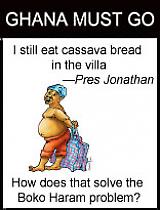
Cartoon of the Day – “I still eat cassava bread in the Villa” -President Jonathan

-Leadership Newspapers

Quit If You Can’t Lead, CAN Tells Jonathan

Dissatisfied with federal government’s style of handling the security challenge posed by the spate of bombings and killing of innocent citizens occasioned by the insurgencies of a terrorist gang, the Christian Association of Nigeria (CAN) yesterday pointedly told President Goodluck Jonathan to step aside if he couldn’t put a stop to the mindless killings in the country.

Specifically reacting to the attacks on Christian worshippers in Kano and Borno states, CAN said, “We are telling President Goodluck Jonathan, if he has not done anything to put an end to this madness, then, he should know that there is trouble in his hand.”

Meanwhile, Taraba State commissioner of police Mr. Maman Sule yesterday narrowly escaped death when a suicide bomber who laid ambush on the route to the commissioner’s office thrust an improvised explosive device (IED), at his convoy.

Although the commissioner escaped unhurt, many security operatives on his entourage were not spared: 11 persons lost their lives in the attack.

But speaking with journalists in Kaduna, the spokesman of the northern CAN, Elder Sunday Oibe, also accused northern traditional rulers of the mindless killings in the region.

He said: “We are telling the emirs, traditional rulers and the political chieftains in the north that they are behind these things and they must bring the perpetrators to book”

“To us, we feel that government is just playing games and politics with the church and the church is not going to take it anymore because anybody who kills is a murderer or arsonist.

“Why is the government becoming helpless to bring these people to book? Is the government telling us that a particular tribe or religion is superior to every other person in this country?

“We are feeling serious pains and disappointment at the entire system called Nigeria. It is highly condemnable in the strongest term because these are innocent students who were sent to school by their parents to acquire education.

“They went to worship their God only for some people to come and sniff lives out of them. It is highly condemnable, it is not just condemnable, but we will not sit down and fold our arms to accept this madness any more.

“This country belongs to all of us, and if truly it is one Nigeria, one indivisible country that has a government to protect lives and property, then, government must do something about it because it is the systematic approach of these murderers which tends to the fact that it is only Christians that are the major targets.

“They do it on Sundays and attack only places of worship owned by Christians. We have mosques scattered all over BUK, nobody has heard any attack on them. They said it is the issue of poverty, but they have not attacked any government infrastructure. If it is the issue of power, then, they should go and fight government. Why is it that it is Christians that they are fighting?

“The irony of this thing is that the people have carefully put a plan in place to eliminate Christians. Total annihilation of Christianity from the surface of this country – that is the target.

“And it seems that the government of this country led by Goodluck Jonathan is helplessly looking on, always telling us that security men are on top of the situation.

“We want to use this medium to tell the world that he has not stepped up to arrest and bring to book the people who carry out this heinous crime, who are behind these things. The country is on the verge of collapse, and no country has ever survived two wars.

“We had survived a civil war, but no country has survived a religious war. Let it be made known that Christians are not taught to retaliate, but Christians have been given the right to defend themselves, and we will do it with all manner of defence we know within ourselves.

“We cannot produce legitimate children, God-given children, beautiful children, sent to school, then people who have no value for life will continue to kill them.

“Christians cannot fold their arms anymore, and we are telling President Goodluck Jonathan if he has not done anything to put an end to this madness, then, he should know that there is trouble in his hand.”

Taraba Attack: I saw bombers force their way into my convoy — CP

A Red Cross information coordinator, M. Umar Waziri, who confirmed that 11 people died in the Taraba State commissioner of police convoy bomb attack, said: “We can confirm that 11 people were killed; 10 people died on the spot, while one person died at the Federal Medical Centre in Jalingo.’’

Waziri also disclosed that 20 others injured by the blast were taken to various medical centres in the city.

The Taraba State commissioner of police, however, told newsmen that the police only confirmed the death of three persons, saying that he escaped death by a whisker.

Explaining the circumstances that led to the attack, he said he was on his way to the office and the bombers struck just when he entered the premises of the state Ministry of Finance which was adjacent to the Taraba police headquarters.

The police boss, who said that investigation had begun towards apprehending the bombers, added:

“The explosives actually hit the official car I was riding in and shattered the windscreen and front bumpers but I escaped unhurt.”

Police sources in Taraba told LEADERSHIP that the bomb which exploded at the premises of the Taraba Ministry of Finance, at about 8.45am when workers were resuming for work after the weekend break, destroyed parts of the building and damaged valuable items.

Police sources said the bombers had the police commissioner as their target, as the explosive was thrown directly at his convoy. One of the explosives hit the rider leading the commissioner’s convoy.

The police headquarters in Taraba is 40 metres away from the main entrance into the finance ministry with the ministry’s premises forming part of the entrance into the building leading to the police commissioner’s office.

“The police commissioner usually has to go through the ministry of finance to enter his office. He was passing by that usual route when the explosives were thrown. So the police commissioner’s convoy was clearly the target,’’ a top police source who preferred anonymity said.

An eye-witness, Mr. Francis Dominic, who also confirmed the attack on the CP, told LEADERSHIP at the scene of the incident that “the suicide bomber, riding a JINCHENG motorcycle with registration number QB 928 LAU, forced his way into the commissioner’s convoy while trying to detonate the explosive device suspected to be a bomb.

“The outrider on the CP’s convoy who noticed how the suicide bomber was trying to force himself into the convoy used his power bike to displace him but, by then, the bomber had already released the explosive with intention to damage the commissioner’s car, but unfortunately, the bomb exploded before he could get to the commissioner’s car.”

Another witness to the bomb blast, Shehu Umar, who spoke with LEADERSHIP in Hausa language, said:

“We saw him as he kicked his bike from the other side of the road when he discovered that the commissioner’s siren was blaring, but we never knew he was that kind of person. All of us that used to stay here are used to seeing the commissioner passing, so we never expected anything new; only to discover a heavy explosion with noise from where the man was heading into the commissioner’s convoy.

“The explosion of the bomb wounded the outrider of the commissioner’s convoy, leaving his left leg broken and one of his eyes badly damaged while several others on the convoy were either killed or severely injured,” he said. A staff of the ministry, Nuhu Titus, was not lucky as he came out at about the time the CP’s convoy was arriving. While he was waiting for it to pass, the blast went off and he was crushed into the nearby drainage.

Meanwhile, the inspector-general of police, Mohammed Abubakar, who had a meeting with the vice president, Namadi Sambo, at the presidential villa yesterday refuted claims that the bomb attack that killed over 10 persons and left many civil servants in the Ministry of Finance building injured was targeted at the state commissioner of police.

Fielding questions from State House correspondents after the meeting with the vice president, the IGP said, “My CP was not the target. It was placed on the road and it exploded; nothing happened to the commissioner and we have made arrests.”

President Goodluck Jonathan yesterday condemned the bomb attack in Jalingo by terrorists, with an appeal to affected communities and Nigerians as a whole to report suspicious persons to security agencies.

Speaking through his special adviser on media and publicity, Dr. Reuben Abati, the president once again reassured Nigerians and foreigners resident in the country that his administration was taking every necessary action to end the spate of terrorist atrocities in the country.

Abati said, “Noting, however, that success in the war against terrorism will be more speedily achieved with greater support and assistance from affected communities, President Jonathan calls on all patriotic Nigerians, once again, to promptly report all suspicious persons to national security agencies.

“Against the background of the recent upsurge in terrorist attacks, the latest of which occurred in Jalingo earlier today, President Jonathan urges Nigerians and foreigners living in the country not to be discouraged or deterred from going about their regular affairs by the persistence of the mindless bombings and gun attacks.

Attack on media, BUK are ploys to destroy nigeria — Jonathan

Similarly, President Jonathan said that last Thursday’s attacks on three newspaper houses and the Sunday attack on Bayero University Kano chaplaincy by suspected terrorists were indicative of the fact that the objective of the terrorist group was to destabilise the country by destroying its sensitive institutions.

He, however, implored Nigerians “not to succumb to despair over the persistence of the terrorist attacks, but to remain assured that the federal government is doing everything possible to ensure that Nigeria overcomes the scourge of mindless terrorism”.

Dr. Abati in another statement noted: “The president urges Nigerians to remain united in their condemnation and rejection of the terrorists, who have shown even more clearly by their latest attacks on the media and the academic community, that their objective is to destabilise the nation and its vital institutions.

“The president deeply regrets this utterly heinous descent to new depths of calumny by the perpetrators of the attack on one of the nation’s citadels of academic endeavour and its members.

“The president conveys his deepest sympathy and condolences to the families of members of the Bayero University community who lost their lives in the attack.”

US, JNI, ACF decry attacks

In a related development, the United States government has stated that Boko Haram and other terrorist groups in Africa were the major sources of instability and underdevelopment in the continent.

This was contained in the reports presented to the United States House Committee on Foreign Affairs by Ambassador Don Yamamoto, the principal deputy assistant secretary for African affairs, on Monday.

Apart from Boko Haram that was largely indicted in the testimony made by the United States official, al-Shabaab, Al-Qaeda (AQIM) and the The Lord’s Resistance Army (LRA) were also said to be part of the reasons the African continent is not stable.

Also, the Jama’atu Nasril Islam (JNI) National Headquarters has expressed shock over the multiple bomb blasts on some media houses in Kaduna and Abuja, and the similar attacks in Yola, Gombe State University and Bayero University, Kano.

JNI however called for restraint on the part of the government, especially on the arrest of innocent people as a way of stemming the tide of insecurity in the country.

In a press release signed by the religious group’s public relations officer (PRO), Alhaji Umar Ahmad Zaria, which was made available to LEADERSHIP in Kaduna yesterday, it noted that human life is sacred and it must be treated as such by all, stressing that “these incidents call for sober reflection of our actions and inactions as a nation”.

It said JNI commiserated with the families of the bereaved and wished their loved ones the fortitude to bear the loss. “In the same vein, we wish all those who sustained injuries from the blast quick recovery and their respective families, the patience and perseverance in managing the patients.”

The JNI, which also called on Nigerians to be security-conscious, stated: “We call on the federal government not to handle with levity the issue of security upheaval the nation is passing through. It is now apparent that there is serious disconnect between security personnel and the citizenry on leading information, hence the need to bridge the gap so that trust and confidence will be restored.”

The Arewa Consultative Forum (ACF), meanwhile, noted that the perpetrators of violence that killed innocent citizens in Bayero University, Kano should embrace constructive dialogue as the only viable path to peaceful coexistence and national security for collective good.

The Forum which condemned the attacks on Christian worshippers said: “The attacks on innocent people in places of worship in Bayero University is worrisome because it conveys some aimlessness on the part of the perpetrators, considering that those affected are not part of causes of any perceived grievances.”

A statement signed by the ACF’s spokesman, Anthony Sani, stated: “ACF submits that time for sheathing of the sword is long overdue and that whatever may be the nature of any perceived grievances, violence resulting in mindless killing of innocent people can never be the solution.

“This is because, however long any conflict may take, it would still be resolved at peace talks.

“ACF also condoles and commiserates with all those who lost their lives and properties and prays to God to provide them with the fortitude to endure what happened and in the hope that they will replace the losses many folds.”

Stop wasting human lives for political motives, Tambuwal warns

The speaker of the House of Representatives, Hon. Aminu Waziri Tambuwal, has asked perpetrators of bomb blast attacks in some states of the country, including that of Bayero University, Kano, and that which occurred in Taraba State to halt their activities, saying no innocent life must be wasted on the altar of political motives.

The speaker, who made the statement yesterday in a press release issued by his special adviser on media and public affairs, Mallam Imam Imam, was reacting to the twin bomb blasts that rocked Bayero University, Kano, and the Ministry of Finance building in Jalingo, Taraba State, on Sunday and Monday respectively.

The speaker equally urged the victims of the attacks and other Nigerians not to despair over the security challenges facing the nation, recalling that many countries of the world had at one time or the other faced various security challenges, but the important thing was that the collective determination of the people of such countries saw them through the dark periods.

“Nigeria is today experiencing its tough challenge. I am however confident that what we are facing will soon be a thing of the past. Our collective resolve as Nigerians who desire peace and stability will triumph over all dark forces in our country,” Tambuwal added.

While commiserating with the families of those who died or suffered injuries in the blasts, Speaker Tambuwal urged the security agencies to unmask those behind the blasts and bring them to justice.

Academics, students now endangered species — Don

A university don and professor of veterinary parasitology, Prof. Barineme Fakae, said yesterday that last weekend’s attack on a university campus which claimed about 17 lives, including those of two professors, was unnecessary.

Concluding that academics and their students were now endangered species, Prof. Fakae, who is the vice chancellor of Rivers State University of Science and Technology (RSUST), said that the university was a centre of knowledge that prepares people that will help the country. He therefore wondered why anybody or group would carry out such act of wickedness on a place that was expected to produce people of integrity and character.

“This type of incident is really unfortunate, unnecessary and uncalled for. If we now attack the centres where we are expecting people who can help the country, then himself it means our future is being threatened.

“Anybody who has respect for the future would not involve in this kind of act. When you attack and kill teachers, students, it is really unfortunate, I must say. And what it means for the university environment is that academics and students are engendered species,” the vice chancellor said.

Police defuse bomb at BUK as gunmen kill ward head

Anti Bomb squad of the Kano State Command of the Nigeria Police,  yesterday defused a bomb suspected to be planted closed to the mosque of the new site of the Bayero University, Kano (BUK).

The bomb, according to the police, was found inside a polythene bag at about 6pm and was left by the side of the mosque at the university.

“It remained few minutes for the bomb to explode when the specialists of the anti-bomb department successfully defused it,” the police said.

According to the police account, the bomb timing had 25 minutes left before explosion, but was defused successfully.

State Police spokesman, Musa Magaji Majiya (ASP) confirmed to LEADERSHIP that the planted bomb was successfully defused by the anti -bomb unit of the state police command. “Thank God, the bomb was diffused before it exploded,” Majiya said.

Meanwhile, the police have confirmed the killing of a Ward Head in Hotoro Quarters of Kano Municipality, yesterday night.

According to the police, the deceased, late Yusuf Ali, was killed by unknown gunmen at about 7.30 pm yesterday.

An eye witness said the gunmen came to the house of the deceased, identified him from among some people, and shot him.

His brother, Ado Umar confirmed the attack and said the matter had been reported to the police.

Spokesman of the police, ASP Magaji Musa Majiya confirmed the incident and said that investigation was ongoing.

Gunmen kill 3 in Yobe 

Gunmen yesterday killed three persons around T-Junction in Potiskum Local Government area of Yobe State.

A source told our state correspondent that the victims were  shot at about  8.30pm by the gunmen in their house at the Residence of Alhaji Shehu Degree around T- Junction area

Confirming the incident, the Acting Area Commander (AC) of the state police command, Nuradeen Sabo, said investigation had begun over the matter. He added that no arrest had been made, saying that  the remains  of the victims had been deposited  at the General Hospital,  Potiskum.


-Leadership

World’s biggest meat-eaters

Kings of the carnivores

Apr 30th 2012, 15:40 by The Economist online

Who eats most meat? Vegetarians should look away

THE world has a burgeoning appetite for meat. Fifty years ago global consumption was 70m tonnes. By 2007—the latest year for which comparable data are available—it had risen to 268m tonnes. In a similar vein, the amount of meat eaten by each person has leapt from around 22kg in 1961 to 40kg in 2007. Tastes have changed at the same time. Cow (beef and veal) was top of the menu in the early 1960s, accounting for 40% of meat consumption, but by 2007 its share had fallen to 23%. Pig is now the animal of choice, with around 99m tonnes consumed. Meanwhile advances in battery farming and health-related changes in Western diets have helped propel poultry from 12% to 31% of the global total. Although populous middle-income countries such as China are driving the worldwide demand for meat, it is mainly Western countries who still eat most per person. Luxembourgers, who top this chart, are second only to Argentinians in beef consumption. Austrians are the keenest pig-eaters, wolfing down 66kg every year—just more than Serbians, Spaniards and even neighbouring Germans. At the other end of the scale, cow-revering Indians eat only 2.6kg of meat each, the least of the 177 countries assessed. See the full data.


Prove your denial, cousin tells Omisore

Omisore

A former Executive Secretary of Amuwo Odofin Local Government Area of Lagos State and a cousin to the former chairman of the Senate Committee on Appropriation, Iyiola Omisore, Mr Abayomi Omisore, has the former seantor  to apologise to the people of Osun State over his purpoted threat to attack the convoy of Governor Rauf Aregbesola.

The former senator has denied the report.

Addressing reporters at the weekend at the secretariat of the state council of the Nigeria Union of Journalists (NUJ) in Iwo Road, Osogbo, the state capital, the former council scribe advised his cousin to respect the office of the governor.

Abayomi, who insisted that the former senator’s denial was not enough, urged him to show proofs that he never  vowed to attack the governor’s convoy.

According to him, the ideal thing for senator to do is to prove the denial beyond doubt in the interest of the Omisore family.

He said: “I cannot deny the fact that we are cousins, but I am distancing myself from that reckless statement. The Omisore family is noble, peaceful and dependable. So, the reckless utterance cannot be seen as the voice of our family. Our father was a great educationist, who built the Oranmiyan Grammar School in Ile-Ife in 1958 and another great school in Jos in 1967. I am sure if he does prove his denial now the Omisore family will soon come out with a position on the matter.”

The former council secretary said Aregbesola made himself a mentor to many young politicians in and outside Lagos, because of his visionary leadership and selfless service.

Abayomi said the governor’s safety is important because of his contributions to the polity.


by Adesoji Adeniyi- The Nation

Post Navigation