Life is short,have fun!!!

Lifestyle, Travel & Photography. If you want a lifetime memory, take a photo.

Boko Haram threatens to attack VOA, Guardian, Daily Trust others

01/05/2012 16:02:00 Premium Times
image
Boko Haram has become Nigeria’s biggest headache of the moment

Boko Haram has named popular newspapers and broadcast media as its new target

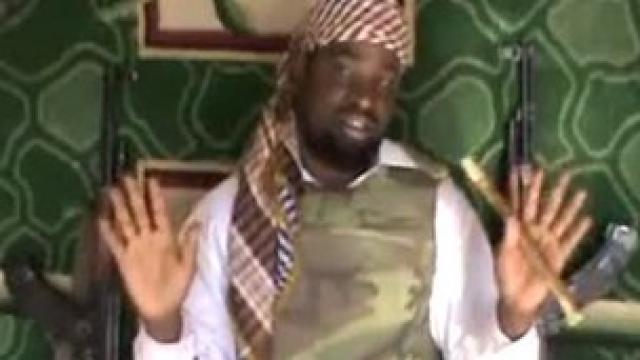
The extremist group, Jama’atu Ahlis Sunna Lidda’awati Wal-Jihadl, popularly called Boko Haram, today named more media houses and staff as targets of its attack (find full transcript of video below).

In an 18-minute video, the group threatened to attack more media houses, naming Voice of America (Hausa), Radio France (Hausa), Daily Trust, Guardian Newspapers, among others.

In part, the video contained footages of the THISDAY blast site apparently downloaded from the websites of CHANNELS TV and PREMIUM TIMES.

The group also gave reasons why it bombed Thisday office in Abuja and other media houses last Thursday.

“This is a message from jamaatu ahlis sunnah lil daawati wal jihad, and we wish to inform Nigerians our reasons for attacking some media houses,” the group said.

The video also shows that the radical group carried a live coverage of the bombing in Abuja and filmed the explosion at Thisday.

The group created the new Youtube video under the name Alhaji Mani.

Click here to watch video: http://www.youtube.com/watch?v=xDqv6srmoI4


Read full transcript of video below.

Boko Haram video transcription

Video has a background music in Hausa language, saying,” Nigerians, our name is not Boko Haram, we are Muslims, Ahlis sunnah”. The lyrics also said, “We attacked Thisday because we will never forget or forgive anyone who abused our prophet.”

First written message says the video is from ‘Public awareness department which presents; ‘Reasons for attacking Thisday Newspaper’

The Video also shows coverage of the suicide attack at Thisday office in Abuja.

It also shows a man wielding a rifle and reciting some prayer verses. Shots of the late leader of the sect Muhammad Yusuf, delivering a sermon, and in other clips, preaching, was shown.

Full transcription

“This is a message from the public awareness department of the Jamatu Ahlis sunnah lil daawati wal jihad, a group engaged in jihad in Nigeria.

“We wish to explain about the attack we carried out on Thisday Newspapers. Some of the reasons why we decided to attack some Media Houses, especially Thisday, is because the paper was used in dishonouring our prophet, Mohammad (SAW) during a beauty pageant in Kaduna in November 2002.

“At that time, some people who called themselves leaders of Muslims came out to say they have forgiven those who committed the offence.

“But based on our knowledge, we know that no one has the power to forgive anyone for an offence that God himself has given judgement, especially on an offence that has to do with dishonouring Prophet Muhammad (SAW).

“No one has the power to forgive this type of offence, and the judgement is for such persons to be killed.

“This lady that committed this crime, the judgement on her is to be killed at any opportunity; and the media house is also supposed to be driven out of existence whenever there is a chance to do so.

“We are just getting the opportunity to attack the media house, and we are hoping to continue these attacks until we drive them out of existence.

“It is our hope that Allah (SWT) will help his religion.

“We know that any genuine Muslim must have been deeply touched by the Thisday incident.
“Thisday newspaper is also leading in helping the government in fighting us, alongside other media houses that we will mention soon.

“Some of the offences of Thisday and other media outlets include: firstly, during the botched attempt to rescue some kidnapped foreign nationals in Sokoto; these media houses asked us if we have anything to do with the kidnap and we said we have nothing to do with it, yet these media houses reported that we were responsible for the incident, that was a lie against us.

“Secondly, when we sent a video of our leader, Abubakar Shekau, the media houses reported things that our leader did not say, such as that in response to the president’s threat to finish us in three months, we have also threatened to finish the government in three months. But the truth is, nowhere in the video did our leader said what they attributed to him.

“Thirdly, on the purported arrest of Abu Qaqa by the SSS, we have come out to tell them that the person arrested was not Abu Qaqa,yet the media continue to potray us as liars, and even said that our leader had ordered for Abu Qaqa II to be executed, and we are now searching for Abu Qaqa III.

“Recently too, they came out with another lie that one Mohammed Awwal Kontagora was the Abu Qaqa II that was executed, and that even his parents confirmed it, that was just a big lie to convince the world.

“The media also said that we have killed the father of Abu Darda, so as to pass a message to him, because he had leaked our secrets after his arrest by security agencies, and they  wanted him to know that he is one of our targets.

“These are all lies, and they are many.

“These media houses have committed a lot of offences that is detrimental to Islam, and we don’t have the power to forgive them. We will take revenge on them by God’s grace, some of these media houses have been categorized into three groups.

“The first group is the likes of Thisday whose offences are big.

“The second group we will also attack soon are Punch, Daily Sun, Vanguard, Guardian, Nation, Tribune, and National Accord, which are all newspaper houses.

“There is also VOA Hausa radio. All these media houses we will attack them including their staff and offices, by God’s grace.

“VOA Hausa for instance have recently started campaigning for people to support the government against us by exposing us,

“The next group that are on the verge of joining this list who if they are not careful we will attack very soon include, Leadership, Daily Trust, Peoples Daily and RFI(Radio France international)

“There is an online medium known as Saharareporters who have their office in New York, and who have made their site as a platform for attack against Islam. So we are warning them to stop making their site an avenue for attacking Islam, otherwise we will find a way of attacking them too.

“We resorted to using this medium to send our message instead of the normal tele-conference because of the fear by journalists; which made them refuse to conduct the conference.

“We are grateful to God for the success recorded on the attack on Thisday, and we hope to continue such attacks.

“Finally, the government has now resorted to arresting our wives and children and also demolishing our houses, like they did in Biu recently, that is why we have also resolved to start attacking government schools, especially, tertiary ones.

“We promise to demolish 500 buildings for any one of our houses that the government destroys.

“We have already started with Gombe and Kano.”

Source : Premium Times Nigeria
RIM’s market share heading below 5%

Jonathan Ratner, National Post
Monday, Apr. 30, 2012

Research In Motion Ltd.’s global market share may soon be in danger of dipping below 5%, according to RBC Capital Markets analyst Mark Sue, who lowered his estimates on the smartphone maker.

With supply chain data showing a backup in RIM products, he now forecasts the company will sell 9 million BlackBerrys in the quarter ending in May. That compares to the consensus estimate of 10.5 million units.

“Limited scale at that point can lead to shrinking operating margins and in our worst case scenario RIM may burn cash next year,” Mr. Sue told clients. “The good news is that RIM has no debt.”

Given the limited visibility to RIM’s near-term fundamentals, the analyst moved his sector perform rating to speculative risk from above average risk, while maintaining a US$13 price target on the stock.

“In our opinion, shares aren’t trading on fundamentals, but instead on the potential for value creating strategies: licensing, partnerships, joint ventures, and other strategic alternatives,” Mr. Sue said.

“In the ever competitive smartphone market, Nokia, RIM, Motorola, Sony, LG, and a slew of others are donating market share while Samsung and Apple continue to gain market share,” he added. “We believe even RIM’s core enterprise market is at risk to rising bring-your-own-device pressures and switching to iPhone and Android. RIM is resorting to price cuts to boost sell-through, but that may not be enough to stem the tide.”

With RIM expected to show off prototype BlackBerry 10 devices at its developer conference in Orlando this week, its high-end LTE device may garner interest from core BlackBerry fans in North America. However, Mr. Sue believes RIM is late to the market as everyone wants apps and RIM has few compared to the competition.

The analyst expects the company’s average selling price will decline by 20% in fiscal 2012, service average revenue per user will dip 11%, and unit sales will fall 19%.

-Financial Post.

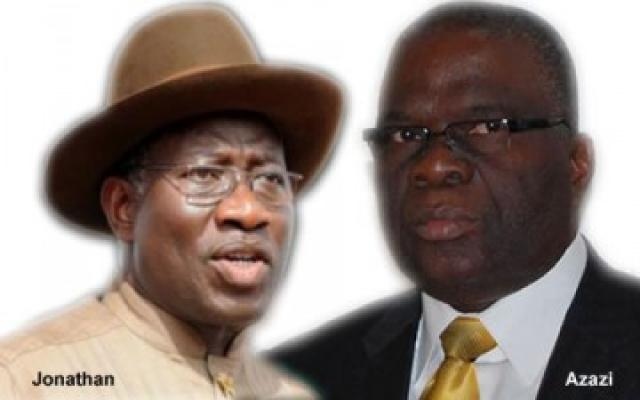
The Fate of Azazi By Aliyu U. Tilde

The fate of Azazi is on the balance. The ruling PDP is turning the heat on the president to do something with the NSA

The indictment of the ruling party in Nigeria (PDP) by the National Security Adviser (NSA), General Andrew O. Azazi, was the misfortune President Jonathan least expected when he woke up from his bed last Friday, 27 April 2012.

The statement must be causing him enormous pain. It has placed him in a predicament, with the party on one hand requesting for the head of Azazi and his kinsmen on the other hand asking for his pardon. To understand the predicament of the president, we need to recast how the two once stood together as comrades in their lifelong ambition of emancipating the Niger Delta.
A Nigeria Army Intelligence Corps (NAIC) inquiry into the gunrunning activities of Sunny Okah at the Kaduna and Jaji military depots when Azazi was the GOC 1 DIV led to the sacking of the latter as Chief of Defence Staff and his premature retirement from the army in 2009. Azazi, as the Chief of Defence Staff, in collaboration with Lt. Col. L.K. Are (then and now DG, SSS) and Maj. General Adekhegba (then DMI), did all he could to cover up the theft and protect its perpetrators, particularly Sunny Okah.
The sacking of Azazi was definitely part of “punitive measures …against prominent figures involved in the theft” which the NAIC report recommended. To be more specific, the report advised “government to sanction Gen Azazi appropriately.” (Full text of the NAIC report can be accessed at: http://saharareporters.com/sites/default/files/uploads/Azazi.pdf.
For my full commentary on the report, read: http://fridaydiscourse.blogspot.com/2010/11/discourse-310-nigeria-cannot-trust.html)
If Azazi was punitively punished for his failure to stop the theft from the depots under his control, the people who the report referred to as “senior politicians in this issue” escaped because investigation into their involvement was overtaken by events. But who were these “senior politicians”, anyway?
The committee found out that Governors James Ibori and Dipriye Alamiyeseigha were purchasing weapons stolen from I DIV and handing them over to Niger Delta militants. Jonathan, which the report shied away from mentioning because he was already the vice-president by the time it was submitted, cannot escape implication since the theft and purchases continued during his tenure as the Governor of Bayelsa state. Also, when the report was submitted, we must remember, James Ibori was the most powerful adviser to late President Yar’adua. Which politician could have been more senior?
Now, we need to know why the NAIC report found it imperative to recommend the investigation of these politicians. Come with me:
“At least the names of two senior politicians… have been mentioned in this investigation. There may be many more. These two politicians are mentioned as the financiers for the arms acquisition project. Certainly, they would not have provided large sums of money without knowing the source of the weapons. Simply put, a serious breach of security of this magnitude deliberately masterminded by the state governors. This gives a serious political dimension to the case.
“It is therefore important that care is taken identifying all possible political linkages to this case with a view to uncovering all the politicians behind this project. Politicians can aspire to any position in Nigeria. One wonders what would happen if Nigeria ends up with a president who does not believe in the entity of the Nigerian nation, and a record of involvement in cases like this. Identifying politicians with complicity in this or similar case will help in ensuring that they are blacklisted and prevented from vying for or taking higher offices because of the implications that could arise.”
Too late.
One of the biggest misfortunes of Nigeria today is that the above warning from the NAIC was not heeded to or “Baba go slow” could not act fast enough. One of those senior politicians, Jonathan, became the acting president barely two years after the report was submitted. What he did after assuming office speaks volumes of his complicity.
Who did Jonathan pick as National Security Adviser after General Aliyu Gusau resigned in 2010? He returned General Andrew O. Azazi!
Who did Jonathan and Azazi find most befitting to run the SSS? They retired Col. LKK Are!
Where is Sunny Okah, the chief gunrunner? He is in the villa assisting the President, especially in the prosecution of his brother who masterminded the October 1 bombings in Abuja.
To whom has Jonathan and Azazi contracted the security of our maritme domain? Niger Delta militant, Tampolo.
From the above, it could easily be discerned that the relationship between the President and his chief security adviser is long standing and strong. How then could the adviser turn around now and blame the ruling party and the President for escalating violence in the country? Let us try and understand what Azazi said. His arrow was direct in its target:
“The issue of violence did not increase in Nigeria until when there was a declaration by the current president that he was going to contest. PDP got it wrong from the beginning. The party started by saying Mr. A can rule, and Mr. B cannot rule, according to PDP conventions, rules and regulations and not according to the constitution. Is it possible that somebody was thinking only Mr. A could win, and if he did not win, he could cause a problem in the society?”
In the above statements, which I quoted from nationalmirroronline.net, there is sufficient understanding on the motives of the security chief: Zoning is the culprit. Power was expected to reside in the North for two terms. But Jonathan, coming from the South, jettisoned that rule and declared his intention to contest. This, according to Azazi, is what increased violence to its present state in Nigeria.
Again, Azazi was not expecting the Northerners that lost to Jonathan – namely, Atiku Abubakar, Generals Ibrahim Babangida and Aliyu Mohammed Gusau – to let the contravention go Scot free. They must cause “problems”. Three things can be gathered from this:
One, had PDP not adopted zoning as a power-sharing principle, according to Azazi, the level of violence would not have reached this unmanageable level.
Two, had the President restrained himself from vying from contesting in 2011, the increase in violence would have been averted, still. Or had Buhari – the northern candidate – won, that too would have silenced the guns of the northerners.
Finally, “the (security) problem in the society”, according to Azazi, is caused by northerners who lost to Jonathan in the PDP, or put in another way, in reaction to Jonathan’s intransigence, Atiku, IBB and Gusau, in reaction, are using Boko Haram to get at Jonathan.
Nigerians are divided on the Azazi’s statement and person. The PDP and its supporters have made statements that portray the security chief as an ingrate, or one that bites the finger that fed him. PDP, they argue, rehabilitated him when it provided the platform on which he is currently serving as the NSA.
The opposition, this time, is raising its thumb for Azazi. He provided it with a powerful ballistic for deployment against the ruling party. And attacking they did, from all fronts. The ACN, CNPP, CPC, etc., are all over the waves enjoying their vindication.
The president must have felt embarrassed by Azazi’s statement though he tried typically to cover him initially by finding excuses in semantics. Azazi, claimed the President, might have had an idea but which he could not express clearly. He referred journalist to Azazi for clarification. That clarification, however, is not forthcoming, so far.
But honestly, could Azazi absolve himself of Jonathan’s violation of the PDP zoning principle? Not at all, in my opinion. He was in the best position, as the NSA, to advise the president on the security implication of his contest, if that is what he believed then. As far as I can recall, nobody reported that he did so then. Neither did he follow his conviction and support any northern candidate.
But granted that he advised the President accordingly, why did he continue as the NSA and even travel to Washington to lure the Americans into believing that Nigeria is under a serious terrorist siege beyond its capacity to contain? Happily, the Americans did not buy the dummy. They said, “Mumu. It is not terrorism. It is poverty. Simple.”
The fate of Azazi is on the balance. The ruling PDP is turning the heat on the president to do something with the NSA. It wants him dismissed. Of course, does the president have a third option, apart from sacking him or keeping him? The choice would not be as easy as Ringim’s. In this situation, the President will be torn among three things: fear, parochial strategy, and his not so much celebrated nerves.
If the President would listen to Niger Delta elders and militants whom he dreads so much, who have turned him into a hostage and who are milking the Nigerian cow dry with the support of Azazi, then he will move to protect the NSA and absolve him of any blame. Let PDP go to hell, he will say. This one has the strongest possibility.

Again, if the President would look at the strategic role of NSA Azazi in the Niger Delta Republic project or his importance to Jonathan 2015 presidency, he will be more inclined to pardon the NSA than to “Ring” him. This option has a good probability.

If, however, he has the mental capacity to understand that the statement is the gross contempt for the President and the ruling party ever uttered by a beneficiary of PDP, then his nerves, if he has any, are likely to persuade him to bid his old comrade farewell. In that case, the Boko Haram missile that hit Ringim would have returned to hit Azazi. The security chief would have nobody to blame but his tongue, which betrayed him under the intense heat of Boko Haram. This one has a weak likelihood.

So, the chances, in my assessment, are strong two against a weak one. Whichever choice the president takes, Nigeria will remain the same – corrupt and insecure.

Source- The Premium Times Nigeria.

20120501-202106.jpg

Frequent-flying females

Hotels need to do much more than put skirt-hangers in closets to woo the female traveller. 

Hotels need to do much more than put skirt-hangers in closets to woo the female traveller.

On your next business trip, take a good look around the airport lounge and in the aircraft’s business class cabin. Chances are you’ll find around one passenger in three is a woman.

Take the same snap poll at your hotel of choice and the numbers should take similar shape.

So why does it sometimes seem that airlines and hotels are ignoring a third of their market?

Advertisement: Story continues below

According to Roy Morgan Research, 35 per cent of Australia’s estimated 2.1 million domestic business travellers – people who’ve made at least one business trip by air within Australia in the last 12 months – are women.

Women also represent 31 percent of Australia’s half-million international business travellers.

A Cornell University report claims that while female businesspeople expect to be treated equally to men, their travel needs are not the same.

“Given the dramatic increase in women business travelers, addressing the needs of this market segment has become increasingly critical for hotels” says Judi Brownell, from Cornell’s School of Hotel Administration.

“Women are developing a clear and consistent message about the need to feel safe, comfortable, empowered, and pampered.”

Brownell says hotels need to do much more than put skirt-hangers in closets to woo the female traveller.

Up in the air

There are some interesting trends in gearing travel towards the female flyer.

Virgin Australia was one of the first airlines in the world to install a ‘Ladies Only’ bathroom in the business class cabin of on its Boeing 777s.

“The Ladies Only bathroom provides additional space and lighting and is valuable when wanting to present a fresh face on arrival after a long haul flight” explains Alison Chalmer, Virgin Australia’s General Manager of Product.

And while a handful of airlines are moving towards unisex inflight amenity kits, Virgin’s female amenity kits for international business class include make-up wipes and a hairbrush.

Another smart touch is the inclusion of a mirror for each seat in Cathay Pacific‘s new business class.

“The mirror is a little touch we added during passenger testing” says Alex McGowan, Cathay Pacific’s Head of Product.

“Ladies said that it would be nice if they could do a little touch-up, and men said that it would be nice if the ladies weren’t doing their makeup in the bathrooms!”

Hotels are also starting to think about female business travellers as more than a person who ticks the ‘Ms’ box on the checkin form.

The Pan Pacific at San Francisco offers female guests a discreet security escort from the lobby to their room.

Wyndham and Loews hotels have set aside ‘networking tables’ in hotel restaurants for solo women who prefer to dine with others rather than sit alone.

And in typically glam style, W Hotels’ ‘Wonder Woman’ packages include three lip glosses, a signature fragrance, black mascara, a silk eye mask and free cocktail.

The bloke-free hotel floor

Some hotels are even opening women-only floors from which all men – not just guests but male porters and room service staff – are barred.

“Women-only floors can be a good idea in cities where women may feel vulnerable when travelling alone” suggests Suzi Dafnis, Community Director of the Australian Businesswomen’s Network.

“If that choice was available to me, I’d probably take it” Dafnis says. “I don’t know any woman that would say no to a room with high-powered hair dryers, a good quality cosmetic mirror and lighting, beautiful bath salts or healthier options on the menu.

“London, Vancouver, Singapore and New York – four cities that where hotels have this feature – don’t strike me as cities where it’d be out of a sense of safety that women would choose to stay in a women-only floor.”

Dafnis also suggests that “Australian standards are also such that safety wouldn’t be the main motivator.”

A business travel survey by the UK’s Barclaycard indicated that only 24 per cent of female business travellers wanted women-only floors, with improved gyms being a higher priority.

That can also include in-room fitness gear for women who’d rather not visit the hotel gym.

Some Hilton and Marriott hotels let you borrow low-tech workout equipment such as mats and weights, while Westin’s dedicated Workout Rooms come with your choice of a treadmill or stationary bike plus extras such as dumb-bells, a yoga mat, Swiss ball, jump rope and even fitness DVDs.

Hong Kong’s Metropark hotel in Wanchai boasts a women-only ‘She’ floor where the rooms are decorated along female lines with ‘themes’ of flowers and ballet and Thann cosmetics.

But women-only floors have met with mixed results as well as mixed response.

In early 2011 Brisbane’s Portal Hotel decreed its fifth floor would be a ‘man-free zone’.

Each of the 11 rooms was stocked with fresh flowers and candles, female toiletries like a cleanser and face mask, hair straighteners and magazines such as Madison, Vogue and Harper’s Bazaar.

There was even a ”Pamper Bar’: think of a mini bar stocked with organic beauty products instead of booze!

While the concept appears to have been well received by guests, the doors to the female-only floor were thrown open to men (and the raft of women’s touches scrapped) when the Portal was rebranded as part of the boutique Diamant chain.

Copenhagen’s Bella Sky Hotel, a conference hotel in the city’s Orestad district, faced legal action last year when a court ruling by the Danish Gender Equality Board decreed that its women-only floor was discriminatory and therefore illegal.

“We have 814 other rooms, and there are 20 reserved for women. That means there are 794 rooms for everyone” said hotel chief Anders Dueland, who has flouted the ruling and continues to keep the ‘Bella Dona’ floor as a haven solely for female guests who value the scented rooms with flowers, and bathrooms fitted with “spacious showers, lots of mirrors and large hair-dryers”.

“In Denmark, there are running races reserved for women, there are bicycle races reserved for women, there are pools where the changing rooms are just for women or just for men” Dueland argues. “There are toilets just for women. Is that discrimination?”

How good are airlines and hotels at catering for women business travellers? And are women-only floors really discrimination or a better way to cater specifically for their needs?

David Flynn is a business travel expert and editor of Australian Business Traveller.

Twitter: @AusBT

Australia cuts its rates more than forecast to 3.75%

Fruit seller in Sydney
A slowdown in consumer price growth has made it easier for the central bank to cut rates

The Reserve Bank of Australia has cut interest rates more-than-expected because economic conditions were “somewhat weaker” than forecast.

It added that inflation had also moderated in recent months.

The bank cut its key rate to 3.75% from 4.25%. Most analysts were expecting a 0.25 percentage point cut.

There have been increasing signs that Australia‘s economy is being hit by a slowdown in global growth and demand for its resources.

“This decision is based on information received over the past few months that suggests that economic conditions have been somewhat weaker than expected, while inflation has moderated,” the Reserve Bank of Australia (RBA) said in a statement.

“Growth in the world economy slowed in the second half of 2011, and is likely to continue at a below-trend pace this year.”

Aggressive support?

One of the biggest headaches facing policymakers over the past year or so has been the fact that Australia was developing a two-speed economy.

While Australia’s mining and resources sector has been booming, the other parts of Australia’s economy have not been doing as well.

Figures out last week only compounded the fears of analysts and politicians.

A report showed that new home sales fell to their lowest level in more than a decade in March. At the same time, home prices have fallen for a fifth straight quarter, while retail sales have shown little growth.

The government welcomed the interest rate move by the central bank.

“This is the interest rate cut that households and small businesses have been hanging out for,” said Wayne Swan, Australia’s Treasurer and Deputy Prime Minister.

“It is very welcome, it is well deserved and it is certainly much needed by households under financial pressure.”

Analysts said that the surprise move by the central bank showed that it was trying to give growth a positive jolt and that it opened the way for more rate cuts in coming months.

“It suggests that the RBA is pretty worried about where growth is headed and some aggressive monetary support was needed,” said Matthew Circosta of Moody’s Economy.

“I think the bias is towards more rate cuts. With the low inflation outlook it gives them scope to cut rates further.

BBC News

‘How Boko Haram attacks have changed the Maiduguri where I grew up’

Security officials search a vehicle along the Gombe-Maiduguri (archive shot)ri expressway in Nigeria Maiduguri residents complain that soldiers do not treat them well
Jimeh Saleh from BBC Hausa returns to his home town of Maiduguri in the far north-east of Nigeria for the first time in almost a year – to find the city is a mere shell of its once lively self, following a spate of deadly attacks by the Boko Haram Islamist group.

As dusk falls in Maiduguri, and the bright afternoon sun gradually turns orange and slowly dips in the evening sky, a muezzin leads the call to pray.

His spirited voice echoes from a pair of loud speakers on a minaret atop one of the oldest mosques in town.

The faithful observe the evening Maghreb prayer – and then have to go straight on to the Isha, the late evening prayer, because Maiduguri has to live under a strict 19:00-06:00 curfew.

Today’s quiet nights – the uncertainty and the insecurity – are a far cry from the Maiduguri I grew up in.

Firmly padlocked houses

My home town, in the far north-east of Nigeria, is also the stronghold the country’s radical Islamist group, Boko Haram.

“We live in constant fear, and you are the only journalist I can talk to, because I know you personally”

And in the past few months, the group has carried out a number of violent and devastating attacks in many parts of Nigeria – including drive-by shootings and bombings in Maiduguri, even the central mosque in December.

Back from London in Maiduguri for the first time in almost a year, the town is as dusty as I left it – but it appears poorer – and so do its industrious and boisterous people.

No more do buses, taxis, beggars, vendors and shop keepers hustle for business late into the night.

Families are no longer able to afford three meals a day.

Property speculators are complaining that business is down, and some are suffering losses.

“Closing shops at 7pm is just like working half-day,” said an economist with the University of Maiduguri who, like most people I spoke to, asked to remain anonymous.

“The economy here is driven by the informal sector which has no closing hours,” he added.

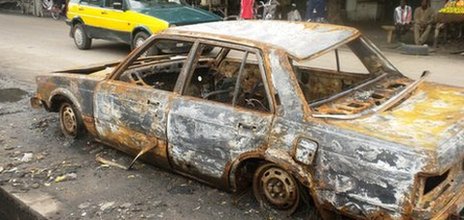
Burnt out car in Maiduguri Boko Haram attacks have left Maiduguri a shell of its former self

“We live in constant fear,” one resident told me, ”and you are the only journalist I can talk to, because I know you personally, but please do not reveal my name.”

Many people fled Maiduguri months ago in the wake of the killings, leaving behind firmly padlocked houses.

Some of the town’s wealthy businessmen have relocated their enterprises to other states.

Soldiers accused

When bombs went off on Christmas Day 2011 in churches in Abuja and Jos killing at least 40 people, Maiduguri was placed under a state of emergency because of the many Boko Haram members who are based there.

Since then, gun-toting soldiers have set up countless checkpoints and taken up positions outside churches, police stations and other high-profile locations that have previously been Boko Haram’s targets.

The soldiers are there to protect the residents of Maiduguri – but people seem united in their condemnation of the curfew and the militarisation of the streets.

They accuse the soldiers of torture and other human rights violations.

Boko Haram squads target soldiers and security agents with explosives, either in their fortified positions or in their patrol vehicles.

After an attack, the soldiers go into neighbouring houses, and are said to indiscriminately beat up the male occupants.

The army denies this is happening – nevertheless, it is a recurring cry that is hard to ignore.

Shoppers’ paradise

Maiduguri’s age-old commercial centre used to be on Babban Layi, which simply means “a wide street”.

It used to be a shoppers’ paradise for textile, electronics, clothing, and household items.

Lebanese and Chadian merchants jostled alongside low-tech con men and pickpockets – all hoping to get a slice of the bulging sacks of money freely freighted around on wheelbarrows.

“Many in town are resigned to their fate and have resorted to prayers to try to rediscover the virtues of peace and hospitality”

Overloaded trucks, known locally as giwa-giwa, transported goods from Babban Layi to neighbouring countries such as Chad and Cameroon, and even to distant places like Sudan and the Central African Republic.

But this once thriving regional trading hub is now almost empty – brought to a virtual standstill not least because the borders were closed as a result of the state of emergency.

For many months now, the labourers who load the trucks, the merchants, the truck drivers and many others have been “surviving by the grace of God”.

The authorities in Maiduguri remain hopeful that things will get better.

“We are not at all pleased by the state of insecurity in Maiduguri and very soon the situation will improve,” Borno state’s information commissioner, Inuwa Bwala, says.

The questions many Maiduguri residents want answered is: When will the borders reopen and when will the army leave the streets?

“Since the state of emergency the federal government has taken over security matters here and the announcement to close the borders was made from Abuja,” Mr Bwala said.

It is, however, not all a tale of gloom – despite the curfew and the explosions.

Among the lucky few are bicycle dealers and mechanics: There has been a boom in sales since the banning last year of motor bikes after a series of drive-by killings were committed by gunmen on the back of bikes.

Despite this glimmer of hope, the situation in Maiduguri seems pretty desperate.

There is a palpable sense of fear.

Many people are resigned to their fate and have resorted to prayer to try to rediscover the virtues of peace and hospitality – which, once upon a time, was the defining feature of my home town.


Boko Haram: Timeline of terror

Map locator
  • 2002: Founded
  • 2009: Hundreds killed when Maiduguri police stations stormed
  • 2009: Boko Haram leader Mohammed Yusuf captured by army, handed to police, later found dead
  • Sep 2010: Freed hundreds of prisoners from Maiduguri jail
  • 2010-2011: Dozens killed in Maiduguri shootings
  • June 2011: Police HQ bombed in Abuja
  • Aug 2011: UN HQ bombed in Abuja
  • Dec 2011: Multiple bomb attacks on Christmas Day kill dozens.

Source : BBC News

badlandsbadley's avatarThe Life and Times of Nathan Badley...

There are some ideas that seem bad. Then there are ideas that set a landmark for awfulness, ideas that make every appalling decision you have ever made seem mildly brilliant. These ideas do not come along very often, so when they do it is always something very special.

Usually these ideas come from a person with far too much money. This is the case with Clive Palmer, an Australian billionaire. Riding off of the high that comes with declaring his run for Parliament, the Australian version of ineffective government, Palmer made a surprising declaration.

Palmer will build the Titanic.

For those who have never heard of the Titanic, it was a huge glamorous ship. In 1912, it launched, sailing from Belfast to New York. Everything was perfect.

Then it hit an iceberg. And sunk.

It sunk hard.

In all 1500 people died, including Leonardo DiCaprio, because, apparently, people can’t survive…

View original post 544 more words

#USA: White House in first detailed comments on drone strikes

Brennan: International law does not ban drones

President Obama’s counter-terrorism adviser has given the most detailed explanation so far of America’s use of drones to kill members of al-Qaeda.

In a speech to a Washington think tank, John Brennan said the strikes were helping to win the war on the militant network.

President Barack Obama wanted to be more open about the practice, Mr Brennan added.

The comments come in the week marking a year since Osama Bin Laden’s death.

BBC Washington correspondent Paul Adams says this is not the first time the Obama administration has confirmed the use of drone strikes.

‘Disaster after disaster’

In January, the president did it himself, during a webchat. But our correspondent says Mr Brennan has gone further than anyone so far in laying out the rationale for a policy that remains controversial.

Mr Brennan said unmanned drone strikes were legal, ethical, necessary and proportional, overseen with what he called extraordinary care and thoughtfulness, especially when the target was an American citizen.

In his speech at the Woodrow Wilson International Center, he said al-Qaeda was losing badly.

For the first time since America’s war on the organisation began, Mr Brennan said it was possible to envision a world in which the core of al-Qaeda was no longer relevant.

He added that drone strikes usually took place with the co-operation of the host government, in “full accordance with the law”.

Such strikes are thought to have killed hundreds of militants in Afghanistan, Pakistan and Yemen.

But Mr Brennan also conceded that there had been civilian deaths as a result of some strikes.

Pakistan has previously demanded an end to US drone strikes on Pakistani soil.

Mr Brennan also said that documents found at the compound where Osama Bin Laden was killed in Pakistan last year would go online later this week.

A protester disrupted the speech and was dragged away by a security guard

They were gathered by US Navy Seals during the raid on Bin Laden’s hideout in Abbottabad on 2 May 2011.

The papers are said to include communication between Bin Laden and his associates, and his hand-written diary.

They are said to reveal that Bin Laden had considered changing al-Qaeda’s name because so many of the group’s senior operatives had been killed.

“In short, al-Qaeda is losing badly. And Bin Laden knew it. In documents we seized, he confessed to ‘disaster after disaster’,” Mr Brennan said, reports AFP news agency.

“With its most skilled and experienced commanders being lost so quickly, al-Qaeda has had trouble replacing them.”

Mr Brennan said the documents would be put online by the US Military Academy’s Combating Terrorism Center.

#Africa : ‘Counter coup’ gunfight in Mali’s capital Bamako

Troops in Mali who launched a coup in March have exchanged fire with the presidential guard in the capital Bamako, officials and witnesses say.

A junta spokesman said guardsmen loyal to ousted President Amadou Toumani Toure were trying to reverse the coup.

The junta later said the situation was back under control, amid reports that several people died in the gunfight.

While the junta has handed power to an interim government, it is still thought to wield considerable influence.

Message on TV

The gunfire followed an attempt by junta loyalists to arrest the former head of the presidential guard, journalist Martin Vogl in Bamako told the BBC.

He said clashes continued around the state broadcasting building and several other locations in the capital late into the night.

One eyewitness told the Reuters news agency that the streets were deserted. Electricity has been cut in several part of the city.

map

Members of the “Red Berets” presidential guards unit reportedly entered the broadcaster’s building, which has been controlled by pro-junta forces since the coup.

“These are elements of the presidential guard from the old regime and they’re trying to turn things around,” junta spokesman Bacary Mariko told the Reuters news agency.

He later said the airport in Bamako had come under attack from anti-coup forces, and that he was expecting an attack on a pro-coup base in Kati, north of Bamako, according to the Associated Press news agency.

But several hours later the junta aired a message on Mali’s TV, saying the airport, the state broadcasting building and the Kati base was under its control.

The 22 March coup, which ousted President Toure, was led by soldiers who accused Mr Toure of failing to combat an insurgency in the north.

Last week the leader of the coup, Cpt Amadou Sanago, rejected the decision of West African regional bloc Ecowas to send troops to the West African country.

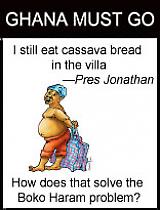
Cartoon of the Day – “I still eat cassava bread in the Villa” -President Jonathan

-Leadership Newspapers

Post Navigation